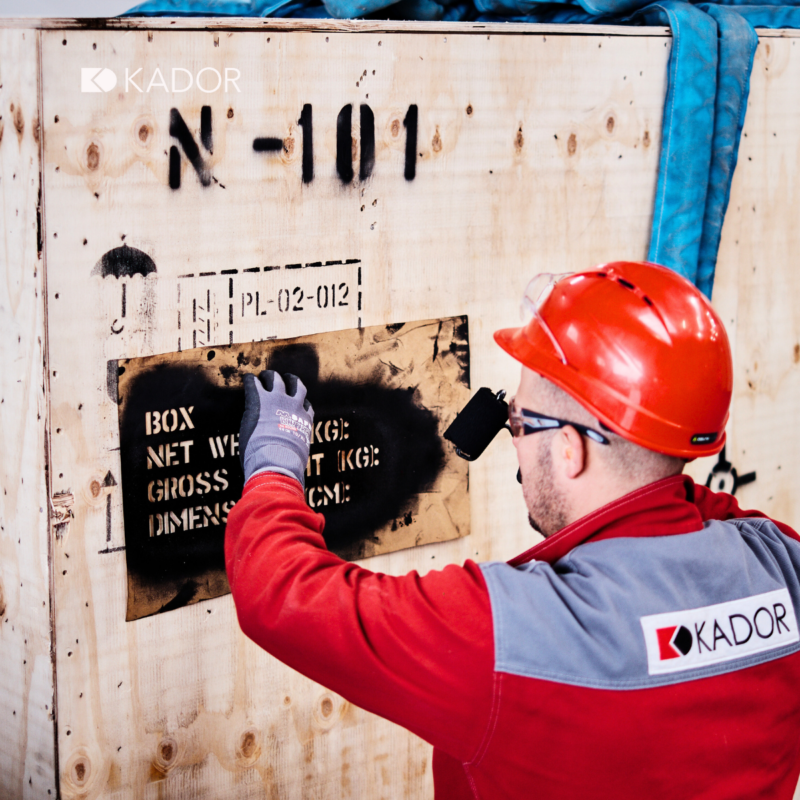
Transport Crate Marking – The Foundation of Safe and Compliant Exports
In international logistics, every detail matters. One of the key – yet often overlooked – elements of the export process is the professional marking of transport packaging. Proper markings ensure cargo safety, smooth customs clearance, efficient identification, and compliance with international standards.
At KADOR, crate marking is treated not as a formality, but as a vital part of high-quality export packaging. With years of experience, expertise in HPE, ISO 780, and ISPM 15 regulations, and a comprehensive approach, we guarantee our clients maximum reliability and process efficiency.
Why does proper crate marking matter?
According to HPE guidelines, missing or unclear markings can lead to serious issues, including:
-
misrouting of goods,
-
improper handling during transport,
-
customs delays and financial penalties,
-
damage or loss of cargo,
-
safety risks to logistics personnel.
To prevent such outcomes, markings must be durable, legible, compliant with standards, and visible from all sides of the crate to ensure correct handling throughout the logistics chain.
What shuld be marked on a transport crate?
Markings are divided into two main categories: text-based and symbol-based. Both are critical in export operations.
1. Text-based markings (DIN 55402 T2 compliant):
-
external dimensions (L x W x H),
-
net and gross weight,
-
package and order number,
-
sender and recipient details,
-
destination,
-
customer reference number.
These markings are essential in international shipping, where even small errors can lead to delays or added costs.
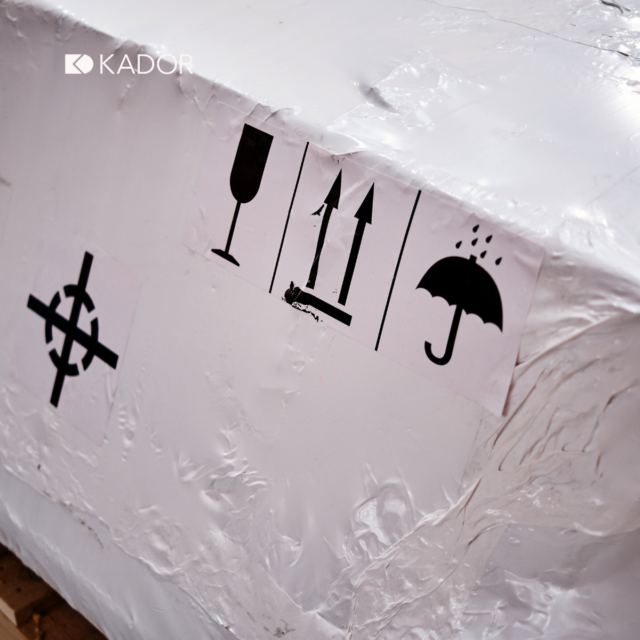
2. Symbol-based markings (according to ISO 780):
-
Fragile (glass icon) – indicates delicate cargo,
-
This Way Up (arrows) – correct handling position,
-
Keep Dry (umbrella) – moisture protection,
-
Centre of Gravity – crucial for load balance,
-
Sling Here – designated lifting points,
-
Do Not Stack – stacking not allowed,
-
Forklift – shows forklift handling areas.
These universal pictograms ensure clear communication, regardless of language or location.
ISPM 15 and the IPPC Mark – Mandatory for Export Outside the EU
Wooden crates shipped outside the EU must display the IPPC marking, confirming the wood has been treated in accordance with ISPM 15 phytosanitary requirements. Missing this symbol can result in customs rejections or cargo being held at the border.
KADOR uses only certified wood and applies the IPPC mark clearly, durably, and in full compliance with global standards.
Customized Markings – Practical and Brand-Enhancing
Many clients seek more than compliance – they want consistent branding throughout the supply chain. At KADOR, we support this by offering:
-
logo placement directly on the crate,
-
custom content markings,
-
individual tracking codes,
-
color-coded markings for modules or components.
Each solution is tailored to the client’s logistics needs and brand identity.
Common marking mistakes to avoid
Despite its importance, crate marking is often treated as an afterthought. The most frequent errors include:
-
missing centre of gravity marking,
-
use of poor-quality or non-durable paint,
-
unreadable or incorrectly placed labels,
-
lack of sequential numbering,
-
failure to remove outdated markings.
These oversights can lead to handling errors, damage, or customs issues – all of which are avoidable with professional support.
Why trust KADOR with crate marking?
At KADOR, crate marking is more than just applying labels. It is a carefully managed process ensuring:
-
compliance with HPE, ISO 780, and ISPM 15,
-
use of long-lasting, moisture-resistant paints,
-
clear, consistent, and legible results,
-
personalized solutions based on your industry and cargo type,
-
expert advice throughout the export process.
Our solutions are trusted by companies in the automotive, electronics, logistics, and pharmaceutical sectors – industries where quality, safety, and timing are critical.
Conclusion
Crate marking is not just a requirement – it’s a strategic component of export success. A properly marked crate minimizes risk, streamlines customs procedures, and reinforces your brand on the global stage.
Looking for a trusted partner to ensure your packaging meets the highest standards? Get in touch with KADOR – we offer expert crate marking and export packaging tailored to your needs.

